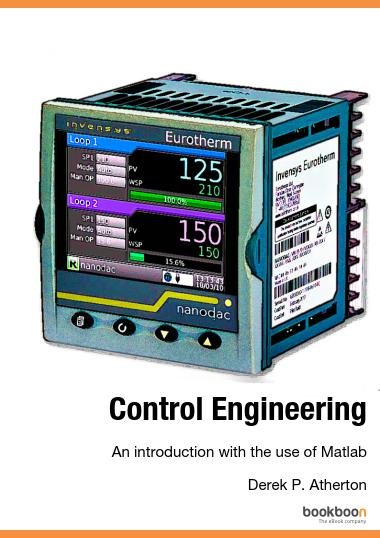
Control Engineering
A practical, theory-driven introduction to control design with MATLAB.
جديد هنا؟ لا تحتاج إلى حساب، سننشئ لك واحداً في ثوانٍ عند الدفع. لديك حساب؟ سجّل الدخول
لماذا تقرأ هذا الكتاب؟
- • Build a clear foundation in linear control models and system responses.
- • Learn stability analysis and frequency-domain tools with worked MATLAB ideas.
- • Understand classical compensator design (lead, lag, PID) and tuning approaches.
- • Extend to parameter optimisation and standard-form controller synthesis.
- • Develop state-space understanding for modern feedback design.
الوصف
Control Engineering (2nd edition) by Derek P. Atherton is an introduction to continuous linear feedback control for single-input single-output (SISO) systems. It develops the core mathematical models used in control—differential equations, transfer functions, and state space representations—and shows how to work with them in MATLAB. The book then studies system responses in the time and frequency domains (including step, impulse, and sinusoidal responses), explains the structure and analysis of the basic feedback loop, and covers stability using multiple criteria. Classical controller design methods such as lead/lag compensation and PID control are presented alongside parameter optimisation and standard forms. Later chapters introduce time-delay effects, root locus, state space methods, and state feedback design, including LQR.
فهرس المحتويات
Preface to the second edition
About the author
1 Introduction
1.1 What is Control Engineering?
1.2 Contents of the Book
1.3 References
2 Mathematical Model Representations of Linear Dynamical Systems
2.1 Introduction
2.2 The Laplace Transform and Transfer Functions
2.3 State space representations
2.4 Mathematical Models in MATLAB
2.5 Interconnecting Models in MATLAB
2.6 Reference
3 Transfer Functions and Their Responses
3.1 Introduction
3.2 Step Responses of Some Specific Transfer Functions
3.3 Response to a Sinusoid
4 Frequency Responses and Their Plotting
4.1 Introduction
4.2 Bode Diagram
4.3 Nyquist Plot
4.4 Nichols Plot
5 The Basic Feedback Loop
5.1 Introduction
5.2 The Closed Loop
5.3 System Specifications
5.4 Stability
6 More on Analysis of the Closed Loop System
6.1 Introduction
6.2 Time Delay
6.3 The Root Locus
6.4 Relative Stability
6.5 M and N Circles
7 Classical Controller Design
7.1 Introduction
7.2 Phase Lead Design
7.3 Phase Lag Design
7.4 PID Control
7.5 References
8 Parameter Optimisation for Fixed Controllers
8.1 Introduction
8.2 Some Simple Examples
8.3 Standard Forms
8.4 Control of an Unstable Plant
8.5 Further Comments
8.6 References
9 Further Controller Design Considerations
9.1 Introduction
9.2 Lag-Lead Compensation
9.3 Speed Control
9.4 Position Control.
9.5 A Transfer Function with Complex Poles.
9.6 The Effect of Parameter Variations
9.7 References
10 State Space Methods
10.1 Introduction
10.2 Solution of the State Equation
10.3 A State Transformation
10.4 State Representations of Transfer Functions.
10.5 State Transformations between Different Forms
10.6 Evaluation of the State Transition Matrix
10.7 Controllability and Observability
10.8 Cascade Connection
11 Some State Space Design Methods
11.1 Introduction
11.2 State Variable Feedback
11.3 Linear Quadratic Regulator Problem
11.4 State Variable Feedback for Standard Forms
11.5 Transfer Function with Complex Poles
Appendix A
Appendix B
Appendix C
Appendix D
معاينة
again and make any suitable changes. Also during the intervening period I have added two further
bookboon books one on ‘An Introduction to Nonlinearity in Control Systems’ and another very recently
on ‘Control Engineering Problems with Solutions’. This later book contains worked examples and some
problems with answers only, which cover the material in this book and ‘An Introduction to Nonlinearity
in Control Systems’. It is hoped that the relevant chapters of ‘Control Engineering Problems with
Solutions’ will help the reader gain a better understanding and deeper knowledge of the topics covered
in this textbook.
Minor changes have been made to this second edition mainly with respect to a few changes in wording,
but sadly despite repeated reading a few minor technical errors were found and corrected, for which
I apologise.



لا توجد تقييمات بعد