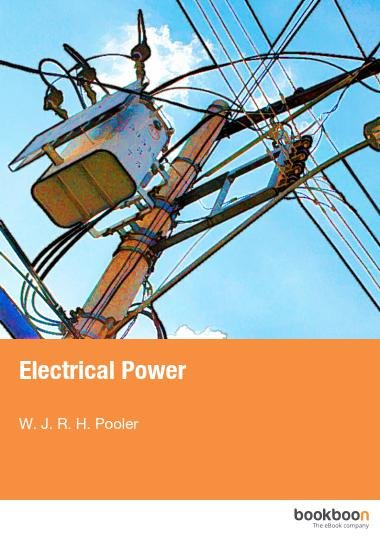
Electrical Power
A practical guide to electricity generation, machines, and power systems.
جديد هنا؟ لا تحتاج إلى حساب، سننشئ لك واحداً في ثوانٍ عند الدفع. لديك حساب؟ سجّل الدخول
لماذا تقرأ هذا الكتاب؟
- • Build a unified understanding from field theory through machines to system faults
- • Use formulas and worked examples for AC/DC circuits, transformers, and motors
- • Learn how protection, earthing, and switchgear respond to faults
- • Follow fault-current calculation logic and commissioning test procedures
الوصف
Electrical Power by W. J. R. H. Pooler is a technical, practice-oriented text covering the physics and engineering used in electrical power systems. It begins with foundations—notation, units, electromagnetism, induced EMF, and electrostatics—then develops core circuit theory for DC and alternating current. From there, it explains AC circuit behavior on resistance, inductance, and capacitance, and extends into machines: DC motors and generators, synchronous machines, and induction motors. Later chapters move through insulation, transformer construction and operation, rectification, power lines, neutral earthing, switchgear, instruments, and protection. The book concludes with power-system concepts, fault-current calculation methods, commissioning and fault finding, and a program manual for fault calculations.
فهرس المحتويات
About the author
Summary
Electromagnetism
Induced EMF
Electrostatics
DC Circuits
Alternating Current (AC)
Resistance, Inductance and Capacitance on AC
AC Circuits
Magnetic Properties of Materials
DC Motors and Generators
AC Synchronous Machines
AC Induction Motors
Insulation
Transformers
Rectifiers
Power Lines
Neutral Earthing
Switchgear
Instruments
Protection
Power Systems
Generator Response to System Faults
Calculation of Fault Currents
Symmetrical Components
Commissioning and Fault Finding
Program Manual
Index
معاينة
A full stop in Bold ( . ) is a decimal point.
A mid line dot ( ) means multiplied by.
A large mid line dot ( • ) means vector dot product. A • B = A B Cos .
Units
cm/gm/sec (cgs) units are;
dyne = force to accelerate 1 gm at 1 cm/sec2
erg = work done by 1 dyne cm
unit pole = magnetic pole that exerts 1 dyne on an identical pole 1 cm distant in a vacuum
G = gauss = magnetic field that exerts 1 dyne on a unit pole
maxwell (previously lines) = magnetic flux = magnetic flux of field of 1 gauss crossing 1 cm2
emu of current = current flowing through an arc of a circle 1 cm radius, length 1 cm which
causes a magnetic field of 1 gauss at the centre of the arc
A coil carrying an electrical current generates a magneto motive force (mmf), which is
measured in Gilberts.






لا توجد تقييمات بعد