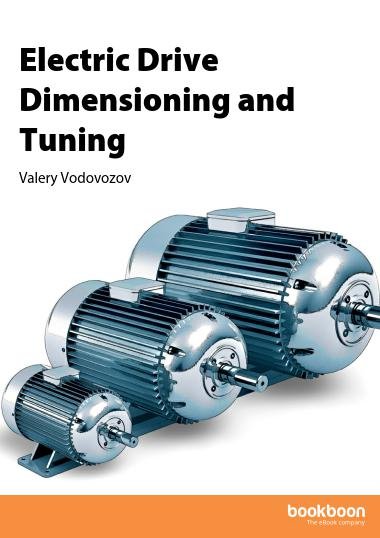
Electric Drive Dimensioning And Tuning
Design and tune electric drives for dynamic and static performance.
جديد هنا؟ لا تحتاج إلى حساب، سننشئ لك واحداً في ثوانٍ عند الدفع. لديك حساب؟ سجّل الدخول
لماذا تقرأ هذا الكتاب؟
- • Learn how to dimension motor-gear-converter sets to satisfy load torque and power requirements.
- • Understand load modeling: inertia, friction, duty modes, and thermal limits.
- • Study how mechanical transmissions and elasticity (oscillations, gaps, backlash) affect control.
- • Build and tune controllers using transfer-function models, filters, and cascade structures.
الوصف
Electric Drive Dimensioning and Tuning explains how to select and match motors, gears, and power converters to meet load requirements, and how to tune the resulting control systems so the drive operates with minimal overshoot, acceptable settling time, and low errors. The book begins with project planning and load calculations, including operating modes, safety factors, thermal and duty considerations, friction, and moments of inertia. It then covers mechanical transmissions and how forces, torques, and elastic effects (gaps, backlashes, oscillations) influence the drive dynamics. The second half focuses on modeling and control: transfer functions, regulator and filter design (analogue and digital), static accuracy, and key control principles such as modal control, sequential correction, and cascading. Practical tuning strategies for speed, combined speed-current, path control, and elastic loads conclude the course.
فهرس المحتويات
Designations
Indexes
Abbreviations
Preface
Project Planning
Project requirements
Operating modes
Motor dimensioning
Design stages
Load Calculations
Moments of inertia
Load calculation formulae
Friction forces
Mechanical Transmissions
Travel functions
Reflecting of forces and torques
Elasticity forces
Load gaps and backlashes
Regulators and Filters
Transfer functions and block diagrams of drive components
Analogue regulators and filters
Digital filters and regulators
Static accuracy of electric drive
Control Principles of Electric Drives
Modal control and standard settings
Sequential correction of simple objects
Sequential correction of complex objects
Cascading
Tuning the Electric Drives
Speed control
Combined speed-current control
Path control
Electric drives with elastic load
معاينة
– Yuly Daniel
There is always an increasing demand for most modular, flexible, and integrated solutions.
This in turn is causing designers to find ways of enhancing their product offerings in response
to such demand. Designs are fast becoming more commonplace, in part because technology
advances are making them easer and also because an integrated solution functions more
effectively as a whole rather than the sum of the individual elements that comprise it.
An electric drive is the electromechanical system that converts electrical energy to mechanical
motion of the driven machine. As a rule, it has more capability than the separate motor,
gear, or power converter in their composition. To meet the application requirements, every
component must be evaluated according to its own capability before selecting it for use on
a drive. This must be considered when selecting and tuning multiple motor-gear-converter
combinations.



لا توجد تقييمات بعد