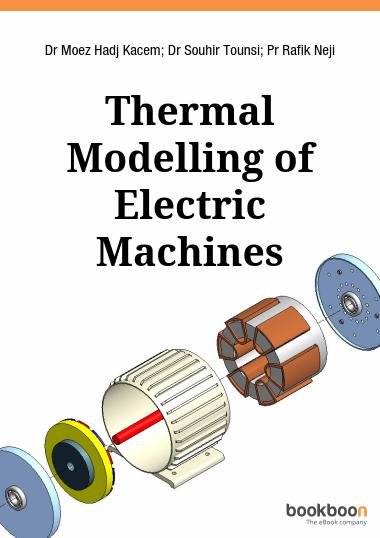
Thermal Modelling of Electric Machines
Build accurate thermal models for electric machines and PMSM cooling
جديد هنا؟ لا تحتاج إلى حساب، سننشئ لك واحداً في ثوانٍ عند الدفع. لديك حساب؟ سجّل الدخول
لماذا تقرأ هذا الكتاب؟
- • Learn analytical thermal modeling methods for electrical machines with permanent magnets.
- • Use a validated thermal model to study topology changes and cooling strategies.
- • Understand how thermal constraints determine power rating and prevent hot spots.
- • See how nodal/thermal-circuit ideas are used to build and simulate temperature behavior.
- • Explore an additional slot-conductor thermal model to capture conductor arrangement effects.
الوصف
This book focuses on the development of a thermal modeling approach for the design of electrical machines using analytical models, with an emphasis on machines with permanent magnets. It presents the methods used to determine the critical parameters of thermal modeling, and then introduces the complete thermal model that is developed and confronted with experimental results. The model is reported to provide good accuracy and is used to investigate how different topological variations affect thermal behavior. The book also examines and compares cooling strategies. Beyond the machine-level model, a related approach is proposed to simulate thermal exchanges between conductors in slots, highlighting the role of the random arrangement of conductors in the coil. The methods are designed to support optimization processes and improve thermal design and thermal management decisions.
فهرس المحتويات
Abstract
Authors’ information
General Introduction
"1 Thermal Characterization Method of the Electric Motors"
"2 Thermal Modeling of a Permanent Magnet Synchronous Machine for Electric Vehicle"
General conclusion
References
معاينة
design of electrical machines. It concerns more particularly machine with permanent magnets.
The methods used to determine the critical parameters of thermal modeling are presented first.
We then present the complete thermal model that has been developed and confronted with
experimental results. This model has very good accuracy and has allowed us to study the effect
of different topological variations on the thermal behavior. It was also possible to analyze and
compare different cooling strategies. This model can easily be integrated into an optimization
process to determine the maximum permissible losses of a given configuration, or to define the
cooling method to use. Based on the same principles, we proposed a new model to simulate the
thermal exchanges between the conductors in the slots. This model allows us to appreciate the
randomness of the arrangement of the conductor ...



لا توجد تقييمات بعد