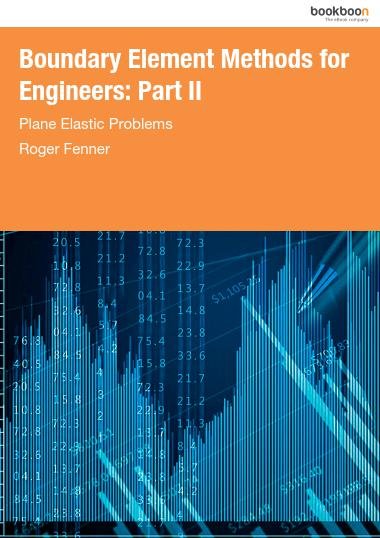
Boundary Element Methods for Engineers: Part II: Plane Elastic Problems
Learn boundary element stress analysis for plane elastic problems.
جديد هنا؟ لا تحتاج إلى حساب، سننشئ لك واحداً في ثوانٍ عند الدفع. لديك حساب؟ سجّل الدخول
لماذا تقرأ هذا الكتاب؟
- • Learn how boundary integral equations are built for plane strain/stress elasticity.
- • Understand quadratic boundary elements, discretisation, and singular integration.
- • See how boundary conditions are handled to compute displacements and stresses.
- • Work through examples and end-of-chapter problems using provided programs.
- • Use the included Fortran (and Matlab) implementations to apply the method.
الوصف
This book is a practical, deliberately simple introduction to boundary element methods for engineers, focused on plane elastic stress analysis. Part II develops the boundary element formulation for two-dimensional elastic problems of plane strain and plane stress. It starts from the fundamental solutions for line forces, introduces the boundary integral equations using Betti’s reciprocal theorem, and explains how to discretise the boundary with quadratic elements. Throughout, the presentation emphasizes the role of kernel functions, numerical integration (including handling of singular terms), and the assembly and solution of the resulting linear systems. Several worked examples and chapter-end problems demonstrate how to apply boundary conditions, compute displacements, tractions and stresses, and solve practical engineering scenarios. For convenience, a Fortran quadratic boundary element program is described in detail, with additional Matlab translations provided in appendices.
فهرس المحتويات
Preface Part I
Notation Part I
Some Program Variable Names Part I
1 Introduction Part I
1.1 Continuum Mechanics Problems Part I
1.2 Some Practical Engineering Problems Part I
1.3 Methods for Solving Harmonic and Biharmonic Equations Part I
2 Boundary Element Analysis of Potential Problems Part I
2.1 Fundamental Solution Part I
2.2 Boundary Integral Equation Part I
2.3 Discretisation of the Boundary Integral Equation Part I
2.4 Constant Boundary Elements Part I
2.5 Quadratic Boundary Elements Part I
2.6 Scaling Part I
2.7 Solving the Linear Equations Part I
2.8 Solving Poisson’s Equation Part I
3 Constant Boundary Element Program for Potential Problems Part I
3.1 Program BEM2PC Part I
3.2 Some Test Problems for BEM2PC Part I
3.3 An Example: Downstream Viscous Flow in a Rectangular Channel Part I
4 Quadratic Boundary Element Program for Potential Problems Part I
4.1 Program BEM2PQ Part I
4.2 Some Test Problems for BEM2PQ Part I
4.3 An Example: Downstream Viscous Flow in a Rectangular Channel Part I
4.4 An Example: Heat Conduction in a Domain of Complex Shape Part I
4.5 Discussion Part I
Appendix A: Gaussian Quadrature Part I
Appendix B: Gaussian Elimination Part I
Appendix C: Matlab Version of Constant Boundary Element Program for Potential Problems Part I
Appendix D: Matlab Version of Quadratic Boundary Element Program for Potential Problems Part I
Solutions to Problems – Part I Part I
Preface 9
Notation 10
Some Program Variable Names 13
5 Boundary Element Analysis of Plane Elastic Problems 20
5.1 Fundamental Solution 21
5.2 Boundary Integral Equations 32
5.3 Discretisation of the Boundary Integral Equations 35
5.4 Boundary Conditions and Surface Stresses 37
5.5 Quadratic Boundary Elements 41
5.6 Scaling 51
5.7 Solving the Linear Equations 51
5.8 Body Forces 51
6 Quadratic Boundary Element Program for Plane Elastic Problems 53
6.1 Program BEM2EQ 54
6.2 Some Test Problems for BEM2EQ 100
6.3 An Example: Confined Compression of a Rubber Block 116
6.4 An Example: Stress Concentration at a Hole in a Flat Plate 118
6.5 Discussion 122
7 Further Applications 128
7.1 Axi-symmetric Problems 128
7.2 Higher-Order Boundary Elements 128
7.3 Three-dimensional Problems 128
7.4 Non-Linear Problems 130
7.5 Comparison with Other Methods 130
Appendix A: Gaussian Quadrature 132
Appendix B: Gaussian Elimination 135
Appendix E: Matlab Version of Quadratic Boundary Element Program for Plane Elastic Problems 141
Solutions to Problems – Part II 188
معاينة
numerical methods for solving engineering problems, and made it possible to solve with good accuracy
many problems which previously could only be solved approximately. Finite difference methods, applied
manually, gave way to finite element methods, which are still one of the most versatile and widely used,
particularly in structural and solid mechanics. In thermofluids, methods of the finite volume type tend
to be preferred.
Slower to develop have been boundary element methods, based on boundary integral equations. Initial
development was largely in the hands of mathematicians, as the underlying mathematics are relatively
sophisticated. It was engineers, however, who turned boundary element methods into practically useful
and powerful techniques.














لا توجد تقييمات بعد